Walk through any major retailer today and turn over a few products.
Made in China. Cambodia. India. Slovenia. UK.
Twenty-five years ago, offshore sourcing was often talked about primarily in terms of cost.
Today, the purchasing decision looks considerably more complicated.
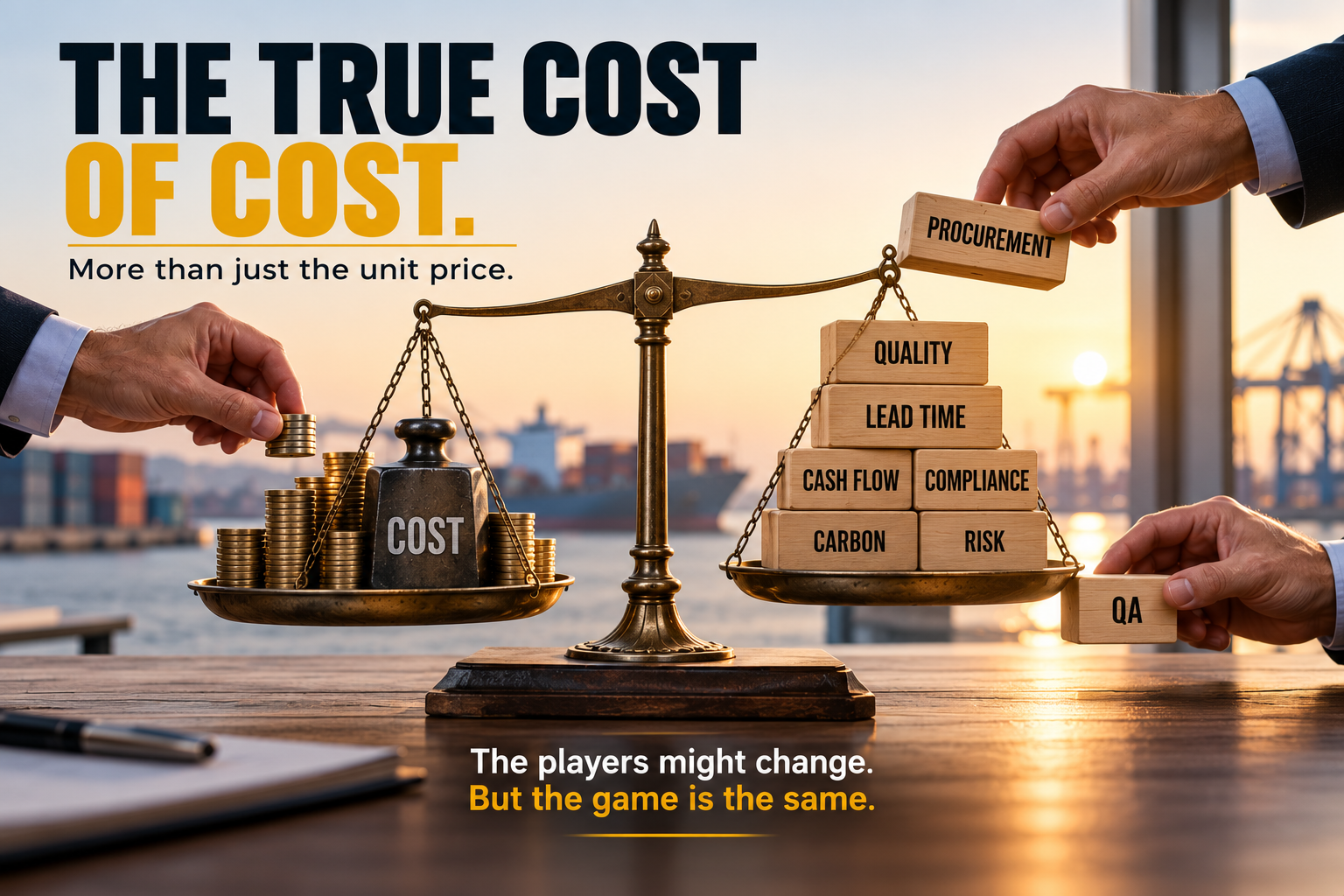
Cost. Quality. Capacity. Lead time. Compliance. Cash flow. Logistics. Carbon. Duty. Risk.
But perhaps the fundamentals haven’t changed at all.
Right now, we’re seeing shipping from Shenzhen to the UK quoted at around 55 days.
If you need product in the UK in January, that extended lead time can push the manufacturing requirement back by a month — straight towards the pressures surrounding Chinese New Year.
Suddenly a logistics issue becomes a procurement issue.
Production needs to be secured earlier. Components need to be committed. Cash leaves the business sooner. Inventory decisions change. And the consequences of getting the forecast wrong become considerably greater.
Then look at components.
Computer component pricing is under pressure as manufacturing capacity and demand move in different directions. Import duties and tariffs around the world can change the economics of a product or market remarkably quickly.
And every additional day or mile in a supply chain carries another consideration: cost, carbon and exposure to events you don’t control.
None of this means international sourcing doesn’t work.
Quite the opposite.
One of the most effective models I’ve experienced is investing more time at the factory — controlling production and quality at source well enough that finished goods can ship directly to the customer.
You remove unnecessary handling, warehousing and duplicated logistics. You can shorten parts of the supply chain, reduce cost and potentially reduce its carbon footprint.
But there’s a catch.
You have to be confident enough to let the product go.
And that confidence comes from the controls you’ve put in place before the container doors close.
That’s where I think the role of QA is sometimes misunderstood.
QA shouldn’t be the department standing at the end of the production line saying no.
Good QA needs to be dynamic.
It should work alongside Procurement from the quotation stage — understanding materials, manufacturing processes, tolerances, supplier capability and where the genuine risks sit.
Sales knows what the customer wants.
Procurement knows what the business needs it to cost.
QA knows what has to happen for both of those things to be delivered successfully.
Sometimes the answer will be no. There have to be red lines.
But good QA should also be looking for the route to yes.
Can we change the material?
Can we change the process?
Can we inspect earlier?
Can we increase sampling?
Can we control the risk at source?
Can we ship directly?
That’s the relationship between risk, aspect and impact that we were applying to manufacturing decisions back in the 1990s.
The terminology has evolved. The technology certainly has. The manufacturing countries, trade routes and commercial pressures continue to change.
But the principle has served me for more than 25 years:
Understand the risk. Understand the impact. Put the controls in place. Then do business.
The players might change.
But the game is the same.
#KeepBuilding