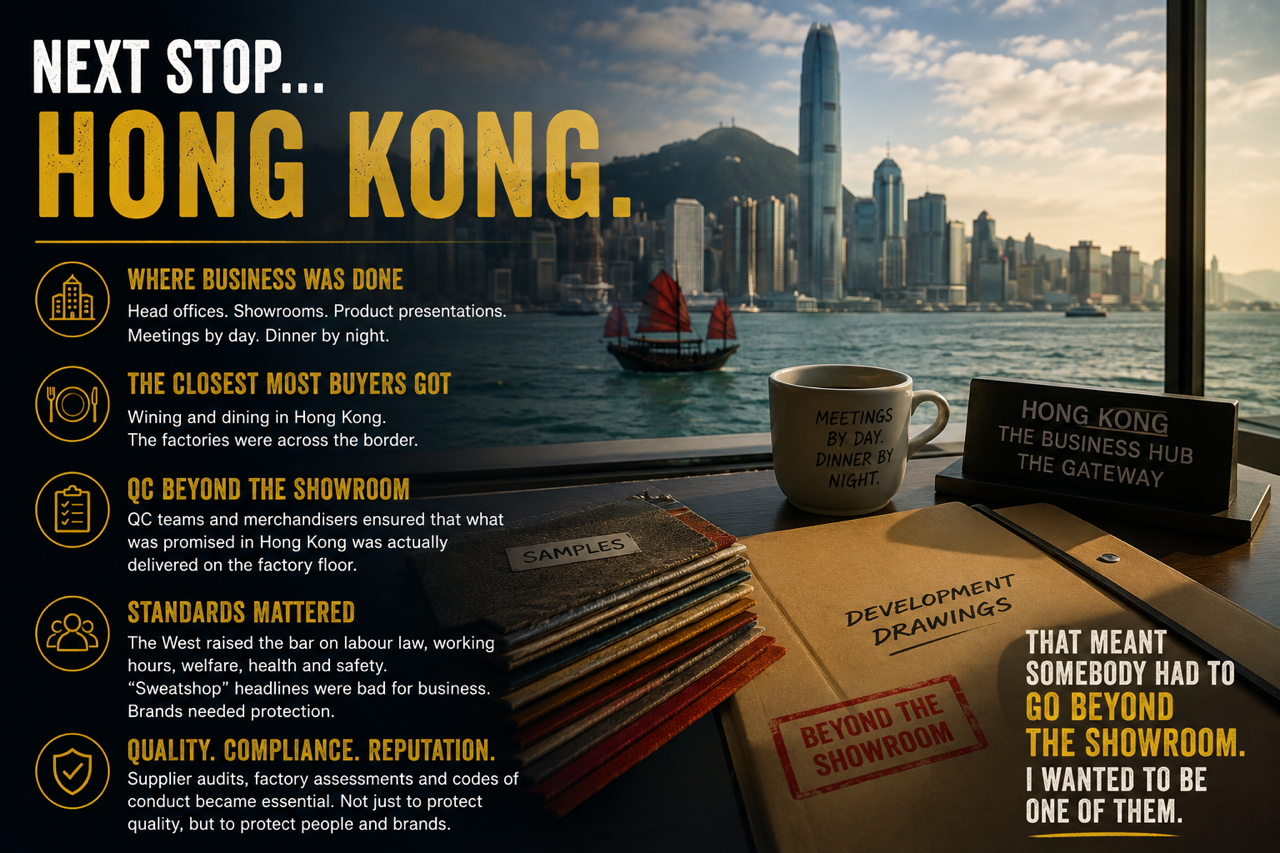
Hong Kong wasn’t just the gateway to China.
In 2000, it was where much of the business was actually done.
The head offices were there. The showrooms were there. Products were presented beautifully, samples lined the walls, and the commercial teams knew exactly how to look after international customers.
Meetings during the day.
Dinner in the evening.
And usually a fair amount of entertaining in between.
For many overseas buyers, that was as close to the manufacturing process as they wanted to get.
The factories were across the border in mainland China, and travelling out to them wasn’t always comfortable or straightforward. That world was largely left to the QC teams, merchandisers, and people responsible for ensuring that what had been promised in Hong Kong was actually being produced on the factory floor.
I became increasingly interested in that side of the business.
Because there could be quite a distance between a beautifully presented sample in a Hong Kong showroom and producing thousands of identical pieces consistently.
And there was another pressure building.
Western brands were becoming far more conscious of what was happening behind the factory gates. Labour conditions, working hours, worker welfare, health and safety and environmental standards were increasingly under scrutiny.
“Sweatshop” headlines were bad for business. They could do enormous damage to a brand.
So QC was evolving too.
It was no longer enough to inspect the finished product and sign off the shipment. Brands needed to understand where, how and under what conditions their products were being made.
Supplier audits, factory assessments and codes of conduct became part of international sourcing. Western expectations were beginning to shape global supply chains, not just to protect quality but to protect workers, reputations, and ultimately the brands themselves.
That meant somebody had to go beyond the showroom.
I wanted to be one of them.
#SupplyChain
#Operations